
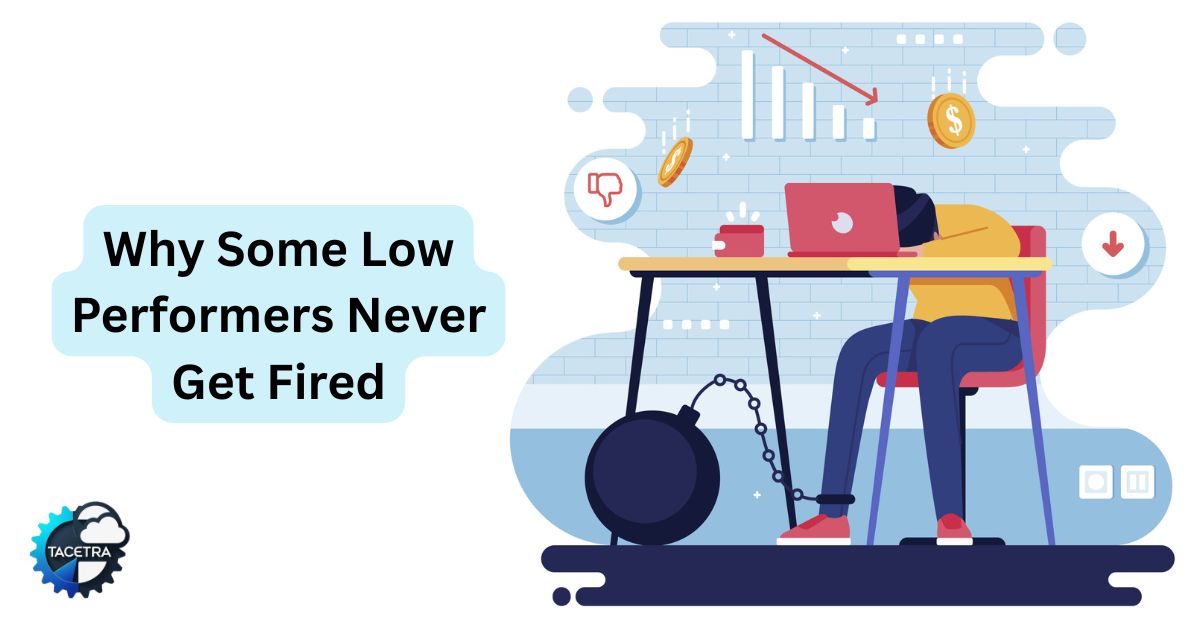
Every experienced leader has been there. You have an employee on your team who just isn’t hitting the mark. They miss deadlines, their output requires constant re-work, and they lack the drive to improve. Yet, month after month, they remain on your payroll.
On paper, the solution is obvious: let them go and hire someone better. But in the messy reality of corporate leadership, logic often takes a back seat. Leaders frequently protect underperformers, not out of incompetence, but as a calculated survival strategy against bureaucratic and systemic corporate hurdles.
Understanding why this dynamic occurs is the first step to resolving it. By shifting from passive management to strategic action, you can protect your team’s culture without burning yourself out.
The Real Reasons Leaders Keep Low Performers
The decision to retain a struggling employee rarely stems from a lack of awareness. Instead, it is usually driven by structural barriers within organizations.
1. The Fear of “Zero Apples”
The most powerful motivator for keeping a poor performer is the fear of losing headcount entirely. Many companies operate under rigid, centralized budget restrictions. If a manager terminates an employee, executive leadership might freeze the position, leaving the team with no backfill at all. In an understaffed environment, a struggling employee who handles even 20% of their workload keeps vital tasks off the manager’s plate. Leaders convince themselves that a flawed contributor is better than an unfilled vacancy.
2. HR Bureaucracy and Red Tape
Firing someone in the modern corporate world is an exhausting, months-long administrative gauntlet. It requires meticulous documentation, uncomfortable weekly alignment meetings, and formal Performance Improvement Plans (PIPs). For a busy leader already stretched thin, spending hours documenting a paper trail feels impossible. Paradoxically, quietly redoing a low performer’s work often feels like the path of least resistance.
3. The Risk of the Unknown
Hiring is an expensive gamble. According to research by the Society for Human Resource Management (SHRM), replacing a mid-level employee can cost up to 150% of their annual salary when factoring in recruiting, onboarding, and lost productivity during training. Furthermore, there is no guarantee the new hire will be any better. Managers often prefer the predictable flaws of “the devil they know” over the financial and operational risks of a total stranger.
4. The Culture Glue
Performance isn’t always measured in spreadsheets. Some employees are technically weak but socially invaluable. They are the team “glue”—well-liked individuals who boost morale, remember birthdays, and handle the tedious grunt work that top performers despise. Firing a beloved team member, even an unproductive one, risks tanking the psychological safety and morale of the entire department.
The Hidden Cost to Your Top Talent
While keeping a low performer might solve a short-term administrative headache, it creates a long-term cultural crisis. High performers are observant. When they see a peer consistently missing targets without consequence, they are forced to pick up the slack.
Over time, your best employees will grow resentful, burn out, and eventually leave. By protecting a low performer to avoid a difficult conversation, you risk losing the very people who carry your business.
Practical Strategies to Break the Cycle
To navigate this dilemma, leaders need to move away from binary thinking—either suffering in silence or jumping straight to termination—and instead use targeted, strategic management techniques.
Build a Metric-Driven Business Case for Your Backfill
Never fire an underperformer without first securing your headcount. To protect your team from a hiring freeze, approach your finance department and executive sponsors with a business case focused on strategic impact rather than emotional frustration.
- Example: Instead of saying, “John is underperforming and I need to replace him,” present data on lost value. For instance: “Our team is missing our software deployment targets by 15% due to a skills gap in our senior developer role. Replacing this position with a qualified engineer will allow us to hit our quarterly product roadmap milestone on time, protecting $100,000 in projected client revenue.” Framing the role around revenue, compliance, or cycle-time improvement makes it significantly harder for finance to cut the headcount.
Shift to Deliverable-Based Accountability
If an employee sits in a performance gray area, remove the ambiguity. Move away from vague feedback like “we need to see more initiative” and shift entirely to project-management-style deliverables. This approach removes personal bias and provides objective data.
- Example: Sit down with the employee and establish clear, time-bound objectives. For a marketing coordinator, you might say: “To meet expectations this month, you need to deliver three campaign briefs by Friday at 5:00 PM, with zero spelling errors and all target metrics filled out.” This creates a clear fork in the road: either the employee gains the clarity they need to improve, or they provide you with an undeniable paper trail of missed targets that will speed up the HR approval process.
Master the Art of “Managing Out”
An outright termination is jarring, legally risky, and emotionally draining. Instead, focus on transparent career alignment—often called coaching someone out. Many low performers are deeply unhappy because they know they are failing. A compassionate leader can help them realize that their skills would be better utilized elsewhere.
- Example: During a regular check-in, map their current struggles to their professional strengths. You might say: “I’ve noticed you struggle with the deep analytical coding required for this role, but you excel whenever you present our updates to client stakeholders. Have you considered transitioning into technical sales or account management? I’d be happy to support your transition to a role that plays to those strengths, whether that’s internally or at another organization.” This approach preserves the employee’s dignity, maintains team morale, and often results in a voluntary departure that avoids HR red tape entirely.
Balancing Empathy and Efficiency
Great leadership requires balancing human compassion with operational excellence. Protecting a struggling employee out of kindness is understandable, but ignoring chronic underperformance is unfair to the rest of your team. By setting unambiguous boundaries, protecting your headcount with data, and helping mismatched employees find the right path, you can build a high-performing culture that respects both people and performance.
Further Reading: Is IT Dead? A Realistic Guide to Choosing Your Tech Career Path
Discover more from TACETRA
Subscribe to get the latest posts sent to your email.
