
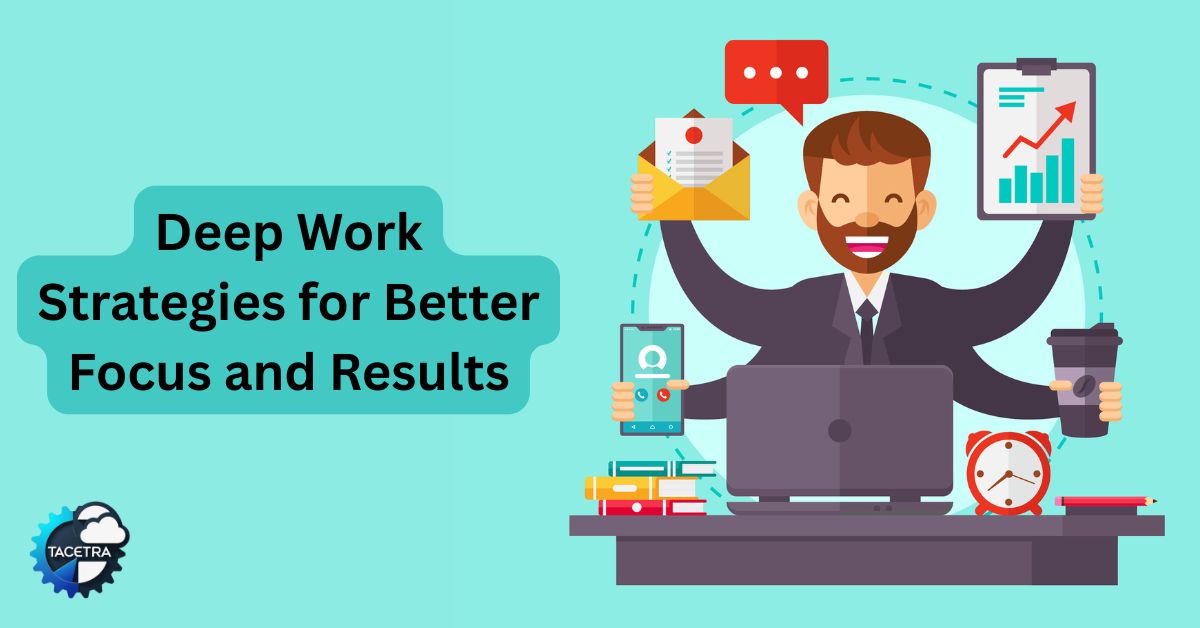
Most people don’t have a time management problem. They have an attention problem.
You can spend an entire day replying to emails, attending meetings, updating spreadsheets, and checking Slack notifications—and still feel like nothing meaningful got done. That’s the core idea behind Deep Work by Cal Newport: not all work creates equal value.
In today’s distraction-heavy workplace, understanding the difference between deep work and shallow work can completely change how you approach productivity. More importantly, it can help you produce better results in less time without burning yourself out.
What Is Deep Work?
Deep work is focused, distraction-free effort spent on cognitively demanding tasks. It’s the kind of work that pushes your brain to think hard, solve problems, create ideas, or build something valuable.
Writing a strategy proposal, coding a complex feature, designing a product, researching a topic, or writing a book chapter all qualify as deep work.
According to Cal Newport’s official site, deep work is becoming increasingly rare while simultaneously becoming more valuable in modern knowledge work. The reason is simple: constant interruptions destroy concentration.
Research from the American Psychological Association found that multitasking reduces productivity because the brain takes time to refocus after switching tasks. Similarly, researcher Gloria Mark from the University of California, Irvine discovered that workers are interrupted roughly every few minutes, and regaining focus can take much longer than expected.
That explains why two uninterrupted hours often produce more meaningful output than an entire distracted workday.
What Is Shallow Work?
Shallow work includes low-value tasks that keep you busy but don’t create significant long-term impact.
Think email replies, status meetings, calendar management, routine admin work, Slack messages, or updating project trackers. These tasks are not useless. Businesses need coordination and communication to function. But shallow work becomes a problem when it consumes most of your day.
A report from McKinsey & Company found that employees spend a large portion of their workweek reading and responding to emails or searching for internal information. That leaves far less time for strategic thinking and meaningful execution.
The danger is that shallow work feels productive because you’re constantly doing something. But activity and progress are not the same thing.
Why Deep Work Produces Better Results
Deep work improves both the quality and speed of your output because it allows your brain to operate without fragmentation.
Psychologist Mihaly Csikszentmihalyi described this focused mental state as “flow,” where concentration becomes so intense that performance and creativity improve dramatically. This is why many high performers protect uninterrupted thinking time.
Bill Gates became famous for his “Think Weeks,” where he isolated himself to read and reflect on future ideas. J.K. Rowling reportedly checked into hotels while finishing the Harry Potter series to avoid distractions and focus entirely on writing.
The pattern is consistent: meaningful work usually requires sustained concentration.
Deep work also helps people develop rare skills faster. Whether you’re learning programming, writing, marketing, or design, focused practice compounds over time. That’s why professionals who consistently produce high-value work often appear more productive than peers who work longer hours.
The Hidden Cost of Too Much Shallow Work
Shallow work creates mental fragmentation. Every notification, message, and meeting forces your attention to shift. Over time, this constant switching reduces mental clarity and increases stress.
One widely cited study from the University of California, Irvine found that interruptions significantly increase stress levels and reduce focus. Meanwhile, excessive meetings and constant communication are now regularly linked to workplace burnout.
The bigger issue is opportunity cost. If you spend four hours daily reacting to notifications, that’s four hours not spent learning a skill, solving a problem, or creating something valuable. Many professionals unknowingly become efficient at low-impact work.
The Best Productivity Strategy Is Balance
Deep work matters more, but shallow work cannot disappear completely. Emails still need replies. Teams still need communication. Administrative work still exists. The goal is not eliminating shallow work. The goal is preventing it from taking over your schedule.
A practical approach is to dedicate your peak energy hours to deep work and batch shallow tasks into smaller windows later in the day.
For example:
- Spend mornings on writing, strategy, coding, or creative work.
- Check email only two or three times daily.
- Batch meetings together instead of scattering them across the week.
- Turn off notifications during focus sessions.
This approach aligns with productivity research showing that focused work periods lead to higher-quality outcomes than fragmented multitasking.
How to Build a Deep Work Routine
The hardest part about deep work is not understanding it. It’s protecting it. Modern tools are designed to interrupt you. That means focus must become intentional.
Start by creating a distraction-free environment. Apps like Freedom or RescueTime can help reduce digital interruptions and track where your time actually goes.
Time-blocking also works surprisingly well. Instead of hoping to focus when you “find time,” schedule dedicated blocks specifically for high-value work.
Many people find that 60 to 90 minutes is the ideal starting point.
It also helps to create rituals around focus. Some people use noise-canceling headphones. Others work in a different location or start sessions with a specific routine. The goal is to train your brain to enter concentration mode faster.
Most importantly, don’t expect eight hours of deep work every day. Even highly productive people usually manage only a few hours of truly focused thinking daily.
Quality matters more than duration.
Deep Work vs. Shallow Work: Which Actually Boosts Productivity?
Deep work wins because it creates outcomes that matter.
Shallow work keeps things running, but deep work drives growth, innovation, learning, and meaningful progress.
The professionals who stand out today are rarely the busiest people in the room. They’re usually the people who can focus deeply on difficult problems while everyone else is distracted.
That’s becoming a competitive advantage.
In a world filled with notifications, constant meetings, and endless digital noise, the ability to concentrate may be one of the most valuable skills you can build.
Frequently Asked Questions
What is Deep Work and why is it important for productivity?
Deep Work is the ability to focus without distractions on mentally demanding tasks that create high-value results. Popularized by Cal Newport in Deep Work, deep work helps professionals complete complex tasks faster, improve problem-solving skills, and produce better-quality work. In today’s distraction-heavy environment, deep work is considered one of the most effective productivity methods for knowledge workers.
What is the difference between Deep Work and Shallow Work?
The main difference between deep work and shallow work is the level of concentration required. Deep work involves focused, cognitively demanding activities like writing, coding, strategy, or research. Shallow work includes routine tasks such as answering emails, attending status meetings, or checking notifications. While shallow work keeps daily operations running, deep work drives meaningful progress and long-term productivity.
Does Deep Work improve productivity more than Shallow Work?
Yes, deep work improves productivity more effectively because it allows people to complete important tasks with greater focus and efficiency. Research on multitasking and attention shows that constant interruptions reduce performance and increase mental fatigue. Deep work minimizes distractions, helping individuals produce higher-quality output in less time compared to shallow work, which often creates busyness without substantial results.
Why do people spend more time on Shallow Work?
Many people spend more time on shallow work because it feels urgent and provides instant feedback. Responding to messages, emails, and notifications creates a sense of accomplishment even when little meaningful progress is made. Modern workplaces also encourage constant communication, making it difficult to protect uninterrupted focus time for deep work.
How can you practice Deep Work in your daily routine?
You can practice deep work by scheduling distraction-free focus sessions each day. Effective strategies include time-blocking, turning off notifications, batching emails, and creating a dedicated workspace for concentrated tasks. Many productivity experts recommend starting with 60 to 90 minutes of focused work daily and gradually increasing the duration as concentration improves.
Can Deep Work and Shallow Work be balanced together?
Yes, the most productive professionals balance both deep work and shallow work strategically. Deep work should be prioritized for high-impact tasks such as creative thinking, planning, or problem-solving, while shallow work can be grouped into shorter time blocks later in the day. This balance helps maintain productivity without ignoring essential administrative responsibilities.
Why is Deep Work becoming more valuable today?
Deep work is becoming more valuable because distractions are increasing in modern digital workplaces. The ability to focus deeply on difficult tasks has become a competitive advantage in industries that rely on creativity, learning, and problem-solving. Professionals who can consistently perform deep work often produce better results, learn skills faster, and stand out in their careers.
Further Reading: I Applied to 500 Jobs and Failed: My New Strategy to Land Interviews in a Brutal Market
Discover more from TACETRA
Subscribe to get the latest posts sent to your email.
