
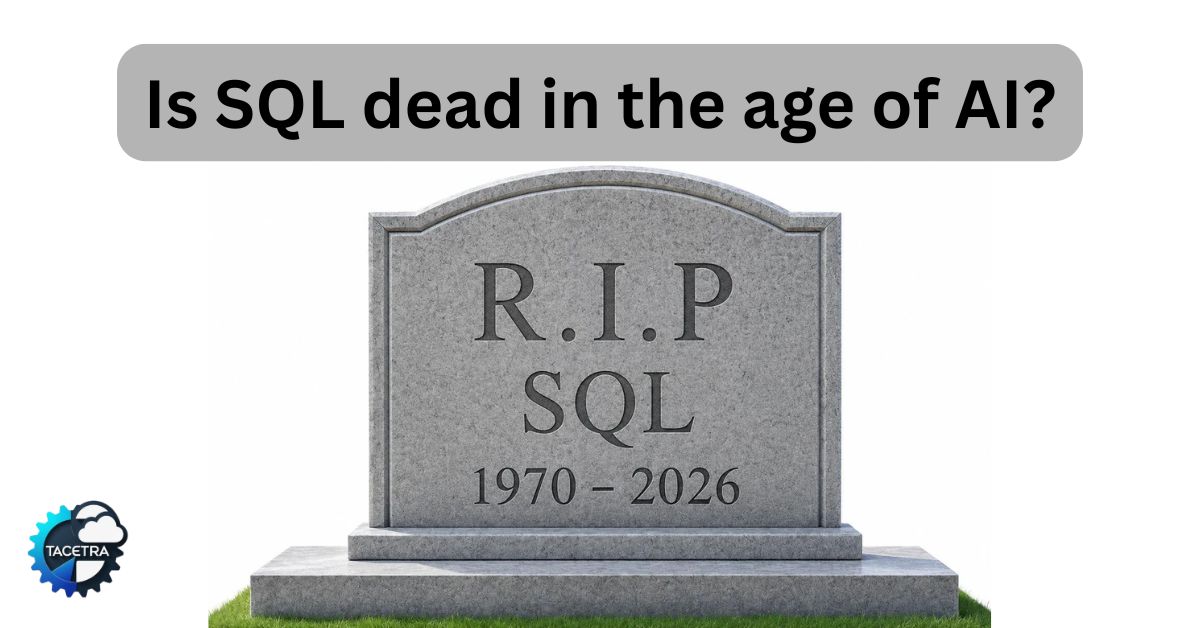
For more than fifty years, the technology industry has routinely declared the death of Structured Query Language (SQL). Every decade, a flashy new alternative emerges, promising to make the tabular relational database model obsolete. In the early days, it was object-oriented databases. Later, the NoSQL movement promised an escape from strict relational schemas. Yet, history repeats itself: the alternatives either fade into obscurity or get quietly absorbed into standard relational structures. Today, nearly every major NoSQL database, with rare exceptions like Redis, natively supports SQL.
Now, we face the latest challenger: Artificial Intelligence. With the rapid evolution of large language models, prominent tech leaders have argued that artificial general intelligence is essentially here, implying that natural language interfaces will soon replace the need for traditional data languages. The dream of “just asking your data” a question in plain English and receiving a perfect answer is a powerful selling point.
However, the operational reality on the ground tells a completely different story. When we move past the controlled product demonstrations and look at actual enterprise data, SQL is not dying. It is becoming more critical than ever.
The Text-to-SQL Accuracy Cliff
The narrative that AI can fully replace database engineers stems from academic performance benchmarks. On clean, well-documented, public datasets consisting of a handful of tables, modern AI models look phenomenal, frequently scoring 90% or higher in accuracy.
But when these same models are tested against actual enterprise environments, they hit a brutal accuracy cliff. A major study introducing BEAVER: An Enterprise Benchmark for Text-to-SQL tested advanced models against real-world private data warehouses. Instead of neat, ten-table schemas, these environments feature hundreds of tables, cryptic column names, missing documentation, and implicit join relationships.
The results were a wake-up call for the industry: frontier models like Claude 4.5 Sonnet and GPT-5.2 achieved accuracy scores of just 11.4% and 10.8% respectively.
When a model encounters a real-world warehouse with 1,400 columns, the entire schema cannot fit usefully into its active memory context window. The AI has to guess which subset of the database matters before it writes a single line of code. If it guesses wrong, the entire output fails. Worse, as noted by researchers tracking enterprise deployments, these systems often suffer from “fluent failure.” They do not return a syntax error; they cheerfully deliver an entirely incorrect metric that looks completely plausible to the end user.
Why the Relational Model is Hardcoded into Human Thinking
The resilience of SQL is not just a technical quirk; it is rooted in how humans process information. For thousands of years, from ancient Babylonian ledger tablets to modern digital spreadsheets, humans have naturally organized structured data into rows and columns. Multi-dimensional, non-linear data structures are incredibly difficult for the human brain to visualize and manage at scale. The tabular layout is our default cognitive tool for organization.
Furthermore, SQL is simply the visual syntax for a much deeper mathematical foundation: the relational model. Tables are just a way to view the data, but the relational algebra underneath provides unmatched consistency, structural integrity, and transactional safety.
Precision Still Matters
Databases are not creative writing tools.
They require exact instructions.
Imagine asking an AI:
“Show me our best customers.”
What does “best” mean?
Highest revenue?
Most purchases?
Longest relationship?
Highest profit margin?
A database cannot guess correctly. Someone must define the criteria.
This is where SQL shines. It forces precision.
A query can clearly specify:
- Revenue greater than $10,000
- Purchases within the last 12 months
- Active account status
That clarity is one reason SQL has remained relevant for decades.
Even if AI generates the query, professionals still need to understand whether the logic is correct.
AI will not kill SQL because AI agents themselves rely on structured logic to interact with the world. Even in a future where humans write less code manually, AI systems will still use SQL under the hood to communicate with data repositories. The language is evolving from a human-to-machine interface into a machine-to-machine lingua franca.
Practical Tips for Bridging the Gap Safely
If you want to leverage natural language AI tools in your data operations without falling off the accuracy cliff, you must design your data environment to handle probabilistic inputs safely.
1. Build a Governed Semantic Layer
Do not point an AI model directly at a raw, unorganized data warehouse and expect reliable metrics. Models struggle when a database contains multiple tables with overlapping semantic meanings, such as four different columns across different schemas that all contain variations of the word “revenue.”
Instead, construct a defined semantic layer that abstracts the messy physical schema into clear, versioned business concepts. By forcing the AI to compile its queries through a regulated semantic layer, you provide the missing business context explicitly. Case studies show that implementing a structured semantic layer can lift data retrieval accuracy from under 20% to near perfection, while significantly reducing compute overhead.
2. Standardize Schema Hygiene and Explicit Relationships
AI models fail on enterprise databases because engineers frequently rely on implicit joins rather than explicitly declaring primary and foreign keys in the database system itself.
To make your database AI-ready, enforce strict schema naming conventions and explicit constraints. Consider this poorly designed schema:
SQL
-- Hard for AI to map reliably
CREATE TABLE usr_tbl (id INT, nm VARCHAR(100));
CREATE TABLE tx_log (tx_id INT, u_id INT, amnt DECIMAL(10,2));
A model trying to join these tables has to guess that u_id maps to usr_tbl.id. Instead, use explicit relational constraints and descriptive names:
SQL
-- Optimized for both humans and AI agents
CREATE TABLE users (
    user_id INT PRIMARY KEY,
    full_name VARCHAR(100)
);

CREATE TABLE transaction_logs (
    transaction_id INT PRIMARY KEY,
    user_id INT,
    amount_usd DECIMAL(10,2),
    FOREIGN KEY (user_id) REFERENCES users(user_id)
);
By explicitly defining the foreign key relationship, you give the AI agent a deterministic map of how the data connects, eliminating a major source of generation errors.
3. Move Logic from Opaque Functions to Transparent Views
Many legacy databases hide complex business logic inside heavily nested user-defined functions (UDFs) or stored procedures. To an AI model, a custom database function is a black box. It cannot see the underlying math, making it highly likely to misuse the function in a query.
Where possible, refactor critical analytical logic into well-documented, transparent Common Table Expressions (CTEs) or standard database views. When the logic is visible in standard relational algebra, the model can decompose the query steps accurately.
What This Means for Your Career
If you’re learning data analytics, software development, business intelligence, or data engineering, this is not the time to abandon SQL. Instead, learn how to work alongside AI.
A practical approach looks like this:
Start by learning basic SQL concepts such as SELECT statements, filtering, grouping, and joins. Resources like SQLBolt provide beginner-friendly interactive lessons.
Then use AI tools to accelerate your workflow.
For example:
- Ask AI to generate an initial query.
- Review the logic.
- Test the results.
- Refine the query as needed.
This mirrors how experienced developers already use AI-assisted coding tools today.
The people who gain the most value from AI are usually those who understand enough to verify the output.
The Future Is AI on Top of SQL
Technology rarely replaces established systems overnight. Instead, it adds new layers of abstraction.
Early programmers worked with machine code. Higher-level languages emerged, but machine code never disappeared. Web frameworks simplified development, but HTML, CSS, and JavaScript still power websites.
The same pattern is likely to continue with databases.
AI will make querying data easier. More employees will be able to access information without writing every query manually. But underneath those interfaces, structured database languages will continue doing the heavy lifting.
The future isn’t “AI versus SQL.”
It’s AI making SQL easier to use.
And that’s very different from SQL becoming obsolete.
Final Thoughts
Every few years, a new technology arrives with claims that SQL is about to disappear. Yet businesses continue storing, analyzing, and reporting data using relational databases. AI is undoubtedly changing how people interact with data, but it isn’t removing the need for structured, reliable database systems.
For professionals and aspiring developers, the smarter move isn’t to stop learning SQL. It’s to learn SQL and understand how AI can make you more productive. The combination of domain knowledge, data literacy, and AI-assisted workflows will likely be far more valuable than relying on AI alone.
Further Reading: The Ultimate Beginner-Friendly SQL Guide (With Clear Examples)
Discover more from TACETRA
Subscribe to get the latest posts sent to your email.
