
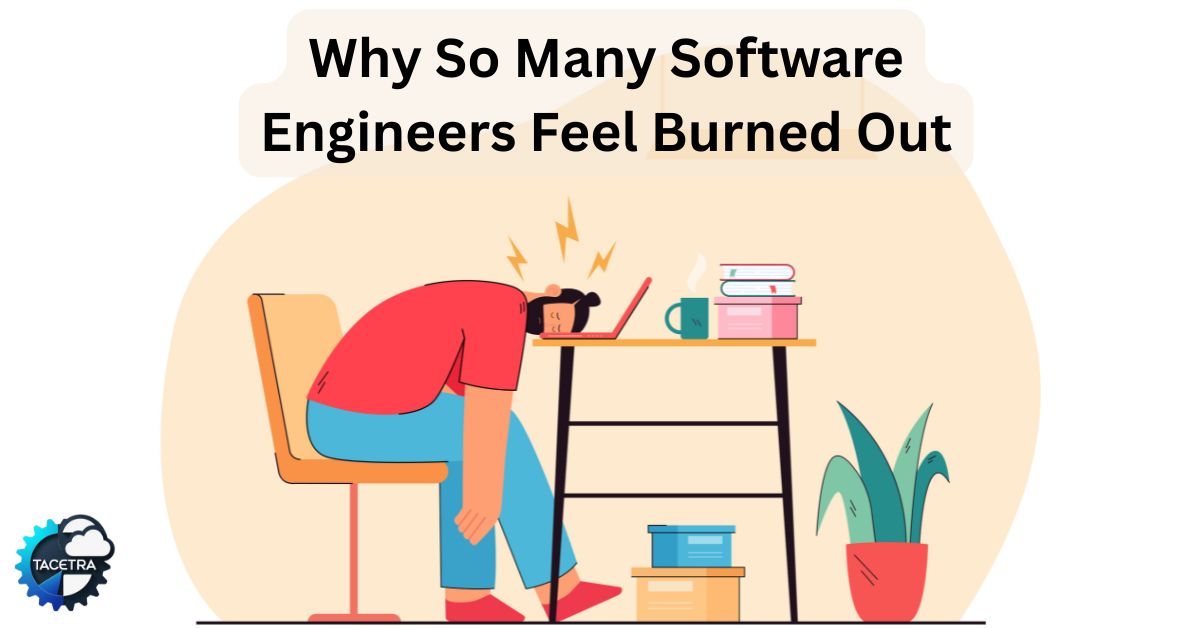
For a long time, the tech industry has been sold as a dream: high salaries, remote work, and the chance to build the future. But if you walk into the engineering floor of a high-growth startup or a Fortune 500 tech team today, the vibe often isn’t “innovation”—it’s survival.
Lately, there is a growing, quiet crisis in software engineering. New grads are entering the field only to find themselves in a state of near-constant mental exhaustion. Senior leads are running on four hours of sleep, acting as the “fix-everything” person in a never-ending cycle of high-pressure releases.
If you feel like you’re barely holding it together, you’re not alone. But to fix the problem, we have to look at why the “mental breakdown” has become a standard feature of the software career path—and how you can opt out of that cycle.
Why the Software Engineering Job Feels So Heavy
The “Constant Sprint” Trap
The biggest culprit behind modern dev burnout is a misunderstanding of Agile. In theory, Agile was designed to make work more manageable. In practice, many companies have turned it into “The Infinite Crunch.”
By breaking work into two-week sprints, the natural ebb and flow of a project is gone. There is no “slow period” after a big launch anymore. Instead, Monday morning after a major release is simply Day 1 of the next high-stakes sprint. When you treat a marathon like a series of back-to-back 100-meter dashes, your body and mind eventually shut down.
The Weight of the “Unknown”
Unlike many professions, software engineering requires solving problems that have no guaranteed solution. You might spend six hours staring at a bug, not knowing if the fix will take five minutes or five days. This constant cognitive load creates a unique type of anxiety. When management demands a “firm estimate” on an “unknown problem,” the pressure becomes a recipe for a breakdown.
Deadlines Decided By the Leadership
Then there’s expectations. Deadlines are often set by people who don’t fully understand the technical complexity involved. When estimates slip, engineers feel responsible—even when the original plan was unrealistic. Over time, this turns into chronic stress rather than occasional pressure.
Interruptions: The Part Nobody Talks About Enough
Software work is deep cognitive labor. You’re not just typing; you’re holding entire systems in your head. Context switching—from meetings to code reviews to production issues—adds hidden fatigue. Research consistently shows that frequent interruptions dramatically reduce productivity and increase mental strain.
When this kind of work happens day after day without boundaries, burnout isn’t a personal failure—it’s a predictable outcome.
Practical Strategies to Reclaim Your Sanity
If you want to survive a 30-year career in this field, you have to stop treating your job like an emergency. Here is how to build a “stress-proof” workflow.
1. Master the Art of the “Trade-Off”
Most developers experience burnout because they never say “no.” However, in a corporate environment, a flat “no” is often seen as being uncooperative. The secret is the Trade-Off Negotiation.
- The Example: Your manager drops a new “priority” feature into the middle of a sprint.
- The Wrong Way: “I’ll try my best to get it done.” (You then work until 11 PM and resent your boss).
- The Right Way: “I can definitely prioritize this. Which of the other three tasks currently in the sprint should I move to the ‘Backlog’ to make room for it?”
This forces management to acknowledge that your time is a finite resource. It shifts the “stress” of the deadline from your shoulders back to the project planners where it belongs.
2. Implement “Deep Work” Buffers
Context switching—the act of jumping between Slack, meetings, and code—is a primary driver of mental fatigue. Research on Deep Work suggests that it takes about 20 minutes to regain focus after an interruption.
- The Action: Block out two 2-hour “No-Meeting” chunks on your calendar daily. Close Slack. Close your browser tabs. When you focus on one problem without the “ping” of a notification, your heart rate actually drops, and your productivity goes up.
3. Build a “Buffer” into Your Estimates
Newer engineers often estimate based on “perfect world” scenarios. They think, “If everything goes right, this takes four hours.” But in software, nothing ever goes right.
- The Example: If you think a task will take one day, quote two. This isn’t “lying”; it’s accounting for the inevitable testing, debugging, and meetings that occur. If you finish early, you look like a hero and get a few hours to breathe. If you hit a snag, you aren’t having a breakdown at 5:00 PM on a Friday.
4. Separate Your Identity from Your Code
In tech, we tend to make our work our entire personality. When a project fails or a senior dev critiques your Pull Request, it feels like a personal attack.
- The Perspective Shift: You are a human being who happens to write code for money. You are not your “story points.” If a company sets an impossible deadline and the project fails, that is a management failure, not a personal one. Learning to “clock out” mentally at the end of the day is a skill that must be practiced as much as Python or Java.
5. Find the “Right” Kind of Boring
Not every job needs to be at a “disruptive” AI startup. Many of the happiest, most balanced engineers work at “non-tech” companies—think insurance, healthcare, or government. These industries often have slower release cycles, better benefits, and a culture that values work-fife balance over “hustle culture.”
6. Move your body—even a little
This sounds obvious, but it matters more in software than many other fields. Physical movement helps regulate stress hormones and reset mental fatigue. A short walk after work or a quick workout before logging in can act as a mental buffer between work pressure and the rest of your life. The Mayo Clinic consistently highlights exercise as a key stress-management tool.
When the Stress Is a Signal
Sometimes, persistent mental exhaustion is telling you something important. It might mean you need clearer boundaries. It might mean the team culture is unhealthy. Or it might mean the role itself isn’t aligned with how you work best.
That doesn’t mean software engineering is the wrong career—it means the current setup is wrong. Many engineers find relief by moving into roles with less constant urgency, such as internal tooling, developer advocacy, or smaller product teams.
Organizations like the World Health Organization now recognize burnout as an occupational phenomenon, not an individual weakness. Remember, this isn’t about “toughening up.” It’s about changing how you work within the realities of the job.
The code will still be there tomorrow. Your sanity might not be if you don’t protect it today.
A More Sustainable Way Forward
Software engineering doesn’t have to come with constant mental breakdowns. The stress many people experience isn’t inevitable—it’s often the result of systemic issues combined with unspoken expectations.
The engineers who stay healthy long-term aren’t necessarily smarter or tougher. They’re better at setting boundaries, choosing environments wisely, and recognizing that no sprint is worth sacrificing their mental health.
If you treat sustainability as a core skill—not an afterthought—you give yourself a chance to build a career that lasts, instead of one that burns bright and burns out fast.
Further Reading: Investing in Yourself: Top Reasons Why Personal Health is Your Best Asset
Discover more from TACETRA
Subscribe to get the latest posts sent to your email.
