
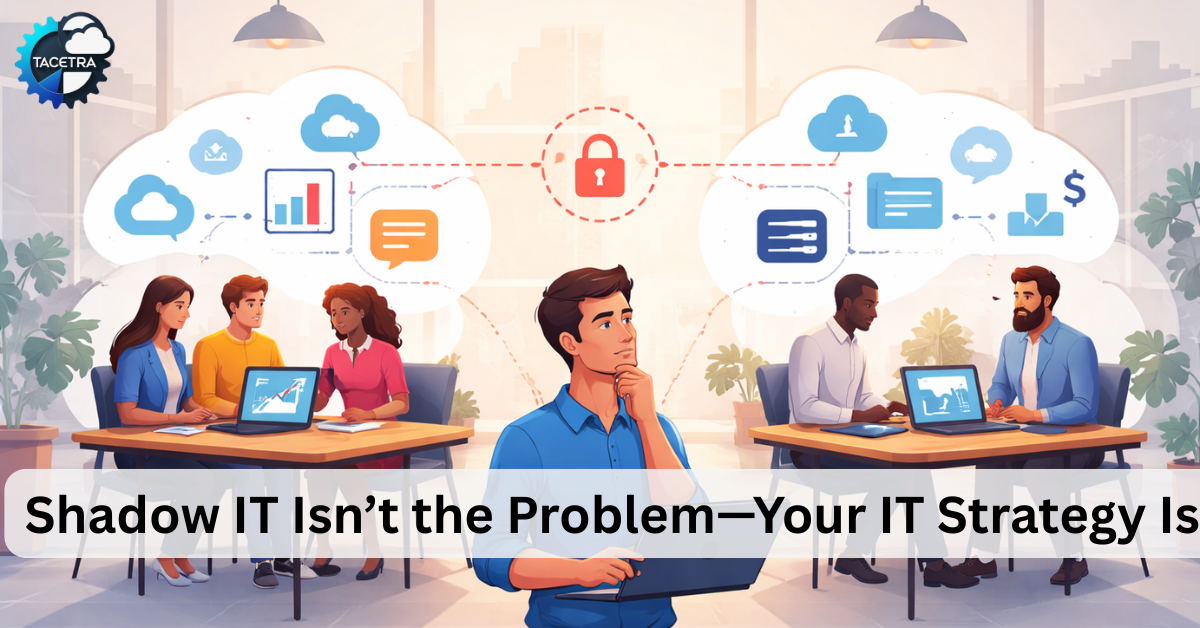
We’ve all been there. You’re reviewing a department budget or checking network logs and you see it: a subscription for a project management tool you never approved, or a department-wide Slack workspace that exists parallel to the company’s official Microsoft Teams environment.
In the IT world, we call this Shadow IT. For years, the traditional response has been to treat it like an infection—something to be quarantined, scrubbed, and banned. But if we’re being honest with ourselves, that heavy-handed approach rarely works. In fact, it usually just drives the behavior further underground.
If your team is bypassing official channels to use their own software, they aren’t trying to be malicious. They’re trying to do their jobs. Shadow IT isn’t a security problem first; it’s a feedback loop.
Why Shadow IT Happens in the First Place
It’s easy to frame shadow IT as a governance failure, but that explanation barely scratches the surface. More often, it’s born out of urgency.
Imagine a sales team that needs better reporting before the end of the quarter. They submit a request to IT, but it gets stuck in a backlog. Deadlines don’t wait, so they find a SaaS tool, swipe a corporate card, and move forward. Problem solved—at least temporarily.
This pattern shows up across industries. When IT processes are slow, overly restrictive, or disconnected from real business needs, teams look for alternatives. According to insights from TechTarget, employees often adopt unsanctioned tools simply to stay productive and competitive.
Listening to the “Signal” in the Noise
Instead of leading with a “Cease and Desist” email, lead with curiosity. The next time you discover a rogue app, sit down with the department head. Ask them, “What problem does this solve that our current tools don’t?” You might find that your official procurement process takes six months, but their project deadline is in six weeks. In that context, “going rogue” is actually a sign of an employee who cares about results.
The takeaway is uncomfortable but important: shadow IT is often less about rebellion and more about survival.
The Real Cost of Ignoring It
That doesn’t mean shadow IT is harmless. Left unchecked, it introduces real risks.
Security is the most obvious concern. Tools that haven’t been vetted may not meet compliance standards or data protection requirements. A well-meaning employee could unknowingly expose sensitive customer data.
Then there’s the financial side. Multiple teams might pay for similar tools, creating unnecessary duplication. Over time, this leads to fragmented systems and bloated budgets.
There’s also a hidden operational cost. When something breaks, IT is expected to fix it—even if they had no role in selecting or implementing the tool. That’s when frustration sets in on both sides.
Practical Tips for Managing the Shadow
To get a handle on the situation without destroying your company culture, consider these three practical shifts:
1. Lower the Barrier to Entry
If your software request form looks like a mortgage application, people will skip it. Streamline your intake process. If a tool is low-risk (e.g., it doesn’t store sensitive customer data), create an “Express Lane” for approval. According to Gartner’s research on cybersecurity evolution, organizations that support “business-led IT” are often more agile and see higher employee satisfaction.
2. Follow the Money
You don’t need expensive scanning software to find Shadow IT; you just need to look at the expense reports. Work with your finance department to flag recurring software subscriptions. Instead of punishing the employee, use that data to see if multiple departments are buying the same “rogue” tool. If five different teams are paying for separate Canva accounts, it’s time for IT to step in, negotiate a corporate discount, and bring it under the official umbrella.
3. Educate on the “Why,” Not the “Rule”
Most employees don’t realize that using a free PDF converter online might mean they are giving a third-party company ownership of the data in that document. When you explain the security risks—like data sovereignty or identity theft—most people are happy to comply. They just need to know that the rules exist to protect them, not to limit their creativity.
Practical Ways to Turn Shadow IT into an Advantage
Start by making IT easier to work with. If requesting a new tool takes weeks, teams will always look for shortcuts. Streamlining approvals or offering pre-approved tool catalogs can make a big difference.
For example, a company might create a list of vetted SaaS tools for marketing, finance, and engineering. Teams can adopt these quickly without going through lengthy reviews, while IT maintains visibility and control.
Another effective move is embedding IT within business teams. When IT professionals understand day-to-day workflows, they can anticipate needs instead of reacting to them. This reduces the likelihood of shadow solutions emerging in the first place.
It also helps to adopt a “guardrails, not gates” philosophy. Instead of blocking everything, define clear boundaries—such as security requirements, data policies, and integration standards. Within those boundaries, give teams flexibility to experiment.
Organizations that embrace this model often see better outcomes. Guidance from National Institute of Standards and Technology emphasizes risk-based approaches to IT governance, where flexibility and security coexist rather than compete.
The Cultural Shift That Makes It Work
At its core, managing shadow IT is less about technology and more about culture. When IT is seen as a gatekeeper, shadow IT thrives. When IT is seen as a partner, it diminishes naturally.
This shift requires humility. It means acknowledging that IT doesn’t always have the best answer upfront. It also requires responsiveness—because trust is built when teams see that their needs are taken seriously.
Over time, this creates a virtuous cycle. Business teams involve IT earlier. IT delivers faster and more relevant solutions. Shadow IT becomes less of a necessity and more of an occasional experiment.
The Rise of Shadow AI
We can’t talk about Shadow IT today without mentioning Generative AI. With the explosion of tools like ChatGPT and Midjourney, the “Shadow” has moved from simple apps to complex data processing. Employees are using AI to summarize meeting notes or write code, often pasting sensitive company IP into public prompts.
This is the highest-risk version of Shadow IT we’ve seen in decades. The fix isn’t banning AI—it’s providing a “Safe Sandbox.” By providing a corporate-governed version of these tools, you give employees the productivity boost they crave while keeping your data inside the company firewall.
Moving Forward
Shadow IT isn’t going away. If anything, it’s becoming more common as tools become easier to access and deploy. But that’s not necessarily a bad thing.
Handled correctly, shadow IT can act as an early warning system—a way to spot gaps in your IT strategy before they become major problems. It can even be a source of innovation, highlighting tools and approaches that IT might not have considered.
The goal isn’t to eliminate shadow IT entirely. It’s to understand it, learn from it, and guide it.
Because when IT and the business start moving at the same speed, shadow IT stops being a threat—and starts becoming an asset.
Further Reading: Is the AI Bubble About to Burst? The Hidden Market Risks Everyone Should Be Watching
Discover more from TACETRA
Subscribe to get the latest posts sent to your email.
