
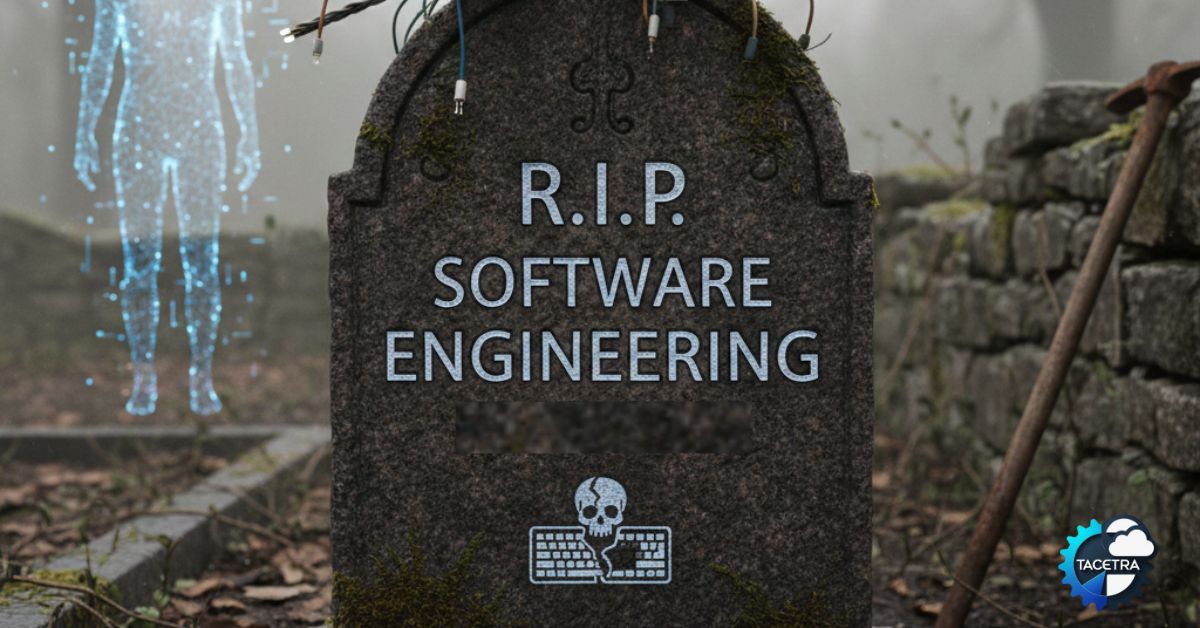
If you’ve spent any time in tech circles lately, you’ve probably felt the collective anxiety. Between the rapid rise of generative AI and a job market that feels more “cautious” than “carefree,” a lot of people are asking the same question: Is the era of the software developer over?
The short answer is no. But the long answer is that the job you’re training for today won’t look anything like the job people had five years ago. We are moving away from a world where “knowing how to code” was a personality trait, and moving into a world where software engineering is about being a high-level architect of solutions.
Here is a look at where the industry is actually heading, stripped of the doomsday headlines.
1. AI is a Coworker, Not a Replacement
There’s a common fear that if an AI can write a function in three seconds, it will eventually write the whole app. But anyone who has actually tried to build a production-level system with AI knows the truth: AI is a fantastic “autocomplete” for boilerplate, but it’s a terrible architect.
A recent study reported by CIO found that over 60% of AI-generated code contains design flaws or security vulnerabilities. We aren’t seeing the death of the developer; we are seeing a shift in the developer’s role from “writer” to “editor-in-chief.” Your value in 2025 isn’t in how fast you can type out a for loop; it’s in your ability to review, audit, and integrate what the machine spits out.
2. The “Junior” Bar is Getting Higher
This is the part that is admittedly tough. Historically, junior devs were hired to handle the “grunt work”—small bug fixes, documentation, and simple features. Today, AI handles that grunt work.
According to market data from Aura Intelligence, the share of job postings for entry-level roles has dipped as companies lean more on senior engineers paired with AI tools. To break in now, you need more than just a bootcamp certificate. You need to understand the fundamentals—data structures, systems design, and security—because when the AI breaks (and it will), you’re the only one who knows how to fix the underlying logic.
3. The Rise of the “Business Technologist”
We’re seeing a massive democratization of tech. Low-code and no-code platforms are projected to power 70% of new applications by 2025. This doesn’t mean developers are obsolete; it means the “simple” stuff is being moved to the business side.
As a professional engineer, your job will increasingly involve building the complex infrastructure that these low-code tools sit on. You become the person who ensures the data is secure, the APIs are scalable, and the various “citizen-developed” apps actually talk to each other.
4. Human-Centric Skills are the New Technical Skills
In a world where code is cheap, “why” becomes more important than “how.” Soft skills—once dismissed as secondary—are becoming the ultimate career insurance.
When a machine can generate a hundred different ways to solve a problem, a human has to decide which one is actually right for the user. LinkedIn workforce data shows that communication, adaptability, and ethical judgment are now top-tier requirements. Being a “code hermit” isn’t a viable career path anymore. You need to be able to talk to stakeholders, understand product-market fit, and navigate the messy human side of technology.
The Verdict: Should You Still Learn to Code?
If you just want to “learn Python” to get a six-figure salary without ever having to solve a hard problem, you might be in trouble. But if you enjoy building things and solving puzzles, there has never been a better time to be in tech.
Software isn’t “done.” As it becomes cheaper and faster to build, we aren’t going to build the same amount of software with fewer people; we’re going to build way more complex things that we haven’t even dreamed of yet.
The future isn’t about competing with the machine—it’s about being the one who knows how to drive it. Focus on the fundamentals, learn to collaborate with AI, and keep your “human” skills sharp. The tools are changing, but the need for builders isn’t going anywhere.
Further Reading: Stop Chasing Frameworks: The 20-Year Programming Lesson That Actually Matters
Discover more from TACETRA
Subscribe to get the latest posts sent to your email.
